Like two parts of a piano duet, Big feels like the perfect bridge between Tom Hanks’ early and later career in film. He may have made a Splash in 1984, but it wasn’t until 1988 that he really hit the Big time. He had a few rocky years before and after that year, but he eventually reached extraordinary heights.
This film revolves around an almost 13-year-old boy named Josh Baskin who wishes to be big, and he wakes up the next morning in the body of a 30-year-old. It’s rather poetic that a movie about the past and future versions of a person would also encapsulate so much about the main actor’s career beforehand and afterward.
I’d like to highlight all the things I’ve noticed in Big that point to Hanks’ previous work and many of the future projects he would be involved in.
Story of Toys
 The most obvious connection to Tom Hanks’ future work in Big is Josh’s obsession with toys. He gets paid to play with them and give his child’s perspective on what’s fun and what’s not. It makes perfect sense why Hanks was cast as Woody in Toy Story. It was a logical step for him to go from loving toys to being a beloved toy. Hanks hadn’t really appeared in a movie about toys per se before Big, but he did appear in 1982’s Mazes and Monsters, where he played a young man who becomes obsessed with a Dungeons & Dragons-type board game.
Evolving Style of Humor
Big manages to combine Tom Hanks’ early raunchier comedy (think Bachelor Party and Dragnet) with his later work where the comedy is more subtle and mature. It accomplishes this feat by having most of the vulgar jokes come from the mouth of a child, which softens their impact, or from Jon Lovitz, and they go over Josh’s head.
Childlike Performance
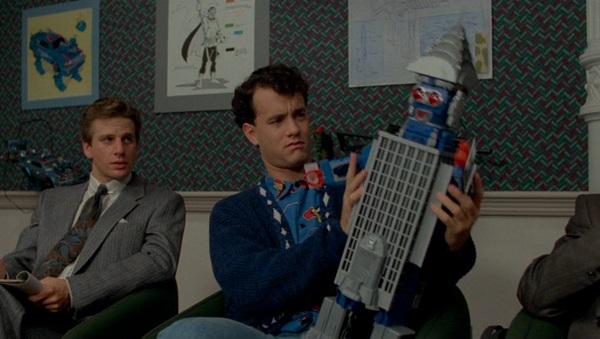 There are early echoes of Forrest Gump’s childlike take on the world in Big. Tom Hanks is playing a child in a grownup body in Big, while in Forrest Gump he acts childlike because of that character’s inability to fully relate to (or understand) the complicated world around him. In both cases, it’s a refreshing view on how things are. Big is a great commentary on the corporate world and how out of touch it can get with the people it’s selling to. Forrest Gump is a clever commentary on the Baby Boom generation and the history of the ‘50s, ‘60s, and ‘70s.
Love Story and Bittersweet Ending
Many of Tom Hanks’ early films are romances. And he’s quite well known for his work on ‘90s romantic comedies with Meg Ryan, especially Sleepless in Seattle and You’ve Got Mail. Big embraces the romantic elements of its story, and the ending is a smart reversal of the usual boy-chases-girl ending. Instead, it’s an executive named Susan Lawrence who chases Josh and tries to stop him from wishing to be a child again.
At the end, they part ways and go back to their normal lives a little sadder and wiser for having loved and lost each other. It’s a bittersweet ending, which seems to speak to Hanks’ roles in Forrest Gump, Saving Private Ryan, and Cast Away. Those aren’t romantic comedies, but they do have bittersweet endings reminiscent of Big.
Saturn V Rocket
 When Josh shows off his apartment to Susan, there’s a fun little detail in there. He’s constructed a scale model of a Saturn V rocket used in the Apollo missions in the ‘60s and ‘70s. It just so happens that seven years after this film, Tom Hanks starred in Apollo 13 as astronaut Jim Lovell. He commanded the very spaceship he had constructed a model of in Big. And Apollo 13 was directed by Ron Howard, who Hanks worked with in Splash.
Steven Spielberg Connection
Tom Hanks’ first connection to Steven Spielberg came in 1986 with Money Pit. Spielberg executive produced that film. His second brush with that famous filmmaker came two years later in Big. Spielberg didn’t have any official connection with this film, but it was co-written by his sister Anne Spielberg and intended as a vehicle for Spielberg to work with Harrison Ford again. When that fell through, the part eventually went to Hanks with Penny Marshall directing. It was a chance for both of them to shine.
Hanks continued to make connections with Spielberg over the years. He starred in the Spielberg-executive-produced Joe Versus the Volcano in 1990 and several films directed by Spielberg protégé Robert Zemeckis, starting with 1994’s Forrest Gump. Finally, in 1998, the two officially made their first movie together, Saving Private Ryan, and they’ve been inseparable ever since.
Academy Award
 Big was the first time Tom Hanks got noticed by the Academy of Motion Picture Arts and Sciences. They nominated him for Best Actor, and he lost to Dustin Hoffman for his performance in Rain Man. That’s actually another interesting Spielberg connection because Steven Spielberg was planning on directing that film, but he had to bow out because of his commitment to directing Indiana Jones and the Last Crusade for his friend George Lucas.
It wasn’t until 1993 that both of them got to be vindicated by working on films that won them their first of two Academy Awards for their chosen craft. Hanks won Best Actor for his role in Philadelphia, and Spielberg won Best Director for Schindler’s List.
Baseball Game
 Tom Hanks’ most famous line of dialogue is probably “There’s no crying in baseball!” from the 1992 Penny Marshall film A League of Their Own. And it just so happens that Josh attends a baseball game in Big with his best friend Billy Kopecki. There’s definitely no crying at that baseball game where the two manage to catch a foul ball and have a grand time at the ballpark. It’s nice that Hanks got to work with his Big director again to deliver another much-needed homerun during a lull in his career.
Big Discovery
What do you think? These strike me as interesting connections, and I hope they’ve been equally interesting and entertaining for you. This is the kind of thing I love doing: making connections that haven’t been obvious before, but they seem perfectly natural once they’re pointed out. Sometimes they’re small and sometimes they’re Big.
This is the Deja Reviewer bidding you farewell until we meet again.
All images are the copyright of their respective owners.
Want to Support the Deja Reviewer? If you’d like to support the Deja Reviewer, please consider donating a few dollars to keep this site going strong. I’ll even send you an original joke if you do! Try it, and prepare to enjoy a good chuckle. $5.00


 Deja Reviewer
Pingback: Movie Matchups: Three Men and a Baby vs. Baby Boom | Deja Reviewer
Pingback: Why Didn’t Steve Guttenberg Become as Big as Tom Hanks? | Deja Reviewer