Man of La Mancha is a movie that’s grown on me over the years. I first saw it as a child, and I didn’t understand it at all. The only musical I enjoyed at the time was Fiddler on the Roof, so that’s what I measured every other musical against. Man of La Mancha wasn’t as funny as Fiddler on the Roof, nor did it pack as much of an emotional punch.
What it does have is a much more complex framing to it, telling a story within a story in which prisoners are playing characters in an improvised stage play. And the way they play those characters is a commentary on their own dismal situations in life. It’s all in service of a trial that will decide the fate of the story itself. Should it be burned, or should it be allowed to continue on and be told for generations?
I could talk endlessly about the amazing framing device and its effect on the story. But what I really want to focus on is the ending of the movie. Or should I say endings?
Premature Ending
 Man of La Mancha demonstrates the importance of getting the ending right. You see, Miguel Cervantes leads his fellow prisoners through a meandering tale in which they all get to have roles. The tale is about a mixed-up nobleman who believes he is a knight named Don Quixote on a noble quest to defeat his archenemy, the Enchanter. Don Quixote surprises jaded people with his misguided gallantry. Some mock him while others are disarmed and inspired to be better because of his example.
Looming over this charade is the fact that Cervantes could be taken at any time by the leaders of the Spanish Inquisition for a different trial. Near the end of the film, the play gets interrupted at a critical juncture when some officials come into the prison. It appears that they’re coming for Cervantes, but they end up taking another prisoner. However, they promise to return soon for Cervantes.
 This couldn’t have come at a worse moment. In the play, Don Quixote has just been brutally ripped out of his fantasy and forced to come face to face with the fact that he’s delusional. His real name is Alonso Quijano. Meanwhile, in real life, Cervantes has had his heart nearly crushed by almost being taken before he’s ready.
The double shock of his character and himself having their facades shattered is too much for Cervantes. He’s ready to give up. He claims to have no ending for his story, which upsets his fellow prisoners. They recognize that this is not the right ending, neither for the story he’s telling nor the one he’s living.
Getting the Ending Right
 To save his story from the fire, Cervantes improvises an ending on the spot. And it proves to be both sad and hopeful at the same time. On his deathbed, Alonso Quijano seems to be resigned to his fate. However, a lady he inspired with his love and adoration for her (however flawed it might have been) comes to his side and revives his adventurous spirit.
Pretty soon Alonso Quijano transforms back into Don Quixote, ready to go off on another grand adventure. Alas, it’s not to be for he dies immediately after getting out of bed. After his funeral, the lady determines to go live a better life in honor of her fallen love.
 Now that’s a fitting ending for the tale of Don Quixote. He got to die in the arms of his love with courage swelling in his heart. And he gets to live on through her, his legacy being one of goodness and joy. She will share his positive influence wherever she goes.
Then it’s Cervantes’ turn to face his own ending. Nothing so dramatic as a death occurs in real life. He is simply led away by the guards to an unknown fate. Of course, in actual history, Miguel Cervantes never faced the Spanish Inquisition or suffered anything like what’s depicted in the film. But none of that matters to the world in which this story takes place. What matters is how the story ends.
 And this film offers a fitting end to Cervantes’ story by having him show courage in the face of danger. He certainly did that many times in his life. In addition, he wins over his fellow prisoners partly thanks to the thrill of being able to play important parts in his imaginative tale. He also gave them a satisfying end to that story, which directly led to a satisfying conclusion to the overall story.
 Mirroring Don Quixote, Cervantes leaves his fellow prisoners feeling inspired enough to sing his own song about dreaming impossible dreams and fighting against unimaginable odds. He has changed seemingly impossible-to-reach souls with his message of hope. They thought he was deluded at first, but by the conclusion of the film, they have been completely won over and are ready to think positively about their own lot in life.
Making Impossible Dreams More Possible
The best stories have the power to affect us and maybe even change us for the better. Not every story has to have a happy ending to do that. Man of La Mancha is both sad and happy. And it demonstrates something interesting.
It wasn’t enough for the story to be engaging most of the way through. Even though the prisoners had all been entertained for a long time and enjoyed playing their parts, they were still ready to throw the story into the fire when they didn’t like its ending. The way a story ends is at least as important as everything that precedes it. And if it can’t stick the landing, it’s often a lost cause.
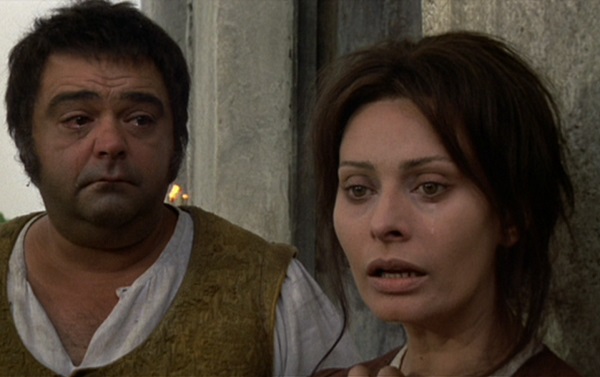 Man of La Mancha got to have two complementary endings. The first contributes to the second while also offering subtle commentary on it. Cervantes wins over his hopeless audience by having his character win over a similarly hopeless lady. And that inspires the true audience (us) to have more hope for the future. Fittingly, I’m at a loss on how to finish talking about this film.
I suppose I’ll improvise an ending, like Cervantes, and simply say that I finally get this movie as a grownup. I appreciate its phenomenal cast, music, and commentary on the nature of storytelling itself. By stranding the author with a literally captive audience, it infuses some intriguing creativity and spontaneity into an already-rich story of bravery in the face of overwhelming odds.
Whatever impossible dream you might have, the way Man of La Mancha tells its story and ends might just make it seem a little more possible.
This is the Deja Reviewer bidding you farewell until we meet again.
All images are the copyright of their owner.
Want to Support the Deja Reviewer? If you’d like to support the Deja Reviewer, please consider donating a few dollars to keep this site going strong. I’ll even send you an original joke if you do! Try it, and prepare to enjoy a good chuckle. $5.00


 Deja Reviewer