Jo is back! She asked me if I could look at The Lion King (1994) to see if it’s a chiasmus. That sounded like a reasonable request to me. After all, she sent me her fully fleshed out How to Train Your Dragon 2 chiasmus, and I did an analysis of How to Train Your Dragon: The Hidden World at her request. So I figured if she saw something in The Lion King, it would be worth checking out.
The Lion King is acknowledged by many as one of the greatest animated films of all time, up there with Beauty and the Beast and How to Train Your Dragon. And both of those films are examples of Cinematic Chiasmus. So why not The Lion King, too? I’m never able to create any suspense in these introductions because if this article is published on my website, you know it’s going to be a chiasmus. Thus, I’ll spare you the long preamble and say yes, The Lion King is a perfect chiasmus.
The first half mirrors the second half, giving the film a beautifully symmetrical structure. It makes sense. A big theme of the movie is the Circle of Life, how history repeats itself and each event in both life and death is meaningful. That’s definitely true when every scene matches up with a previous one in this film.
I’ve got a secret to share about this chiasmus. Meet me at the water hole at the end, and I’ll tell you what it is (*wink). Let’s take some pride in our work as we explore the great circle of The Lion King’s chiasmus.
The Chiasmus
The story of The Lion King comes full circle in this way.
A. The Pride Lands are shown in all their glory as Simba is crowned the next king after Mufasa
B. Mufasa confronts Scar over his failure to appear at Simba’s presentation, Scar wishes he could be king, and Scar slinks off in defeat while Zazu wishes death on him
C. Rafiki draws a picture of Simba to commemorate the future king
D. Mufasa shows Simba the extent of his kingdom, and then he is horrified to learn that hyenas have been spotted in the Pride Lands
E. Scar tells Simba about the elephant graveyard and discourages him from going there
F. Nala is introduced while getting a bath from her mom, and Simba is scooped up by his mom, too, and gets licked
G. Simba and Nala are distraught to learn that Zazu has to join them
H. Simba tells Nala about the elephant graveyard, and she reacts joyfully, prompting Simba to shush her as they walk
I. Simba and Nala sing a song to distract Zazu from his duty long enough to get away from him
J. Simba explores a shadowy wasteland (the elephant graveyard) with his old friend Nala
K. Mufasa rescues Simba and Nala from an attack by hyenas and makes Simba feel terrible by confronting his mistakes
L. Mufasa reconciles with Simba and tells him what he believes about his dead ancestors, who he’ll join in death
M. Scar promises to kill Mufasa and begin a new era with the hyenas in the Pride Lands
N. Scar tells Simba to stay still, then he signals his hyenas to chase wildebeests to kill Simba and Mufasa
O. Mufasa clings to life, gets cut in his paws by his brother, and is thrown to his death among stampeding wildebeests
O. Simba finds Mufasa’s lifeless body, sadly climbs under his father’s paw, and acts as if he were dead after a final wildebeest runs by
N. Scar tells Simba to run away, then he tells his hyenas to chase Simba and kill him
M. Scar tells the lionesses that Mufasa is dead and a new era with the hyenas in the Pride Lands has begun
L. Rafiki mourns Mufasa’s death and believes that his lineage won’t continue because Simba is dead, too
K. Timon and Pumbaa save Simba from a group of buzzards and help him feel better by ignoring his mistakes
J. Simba explores a bright jungle (his new home) with his new friends Timon and Pumbaa
I. Zazu sings a song to Scar, and then Scar tries to distract the hyenas from their problems and sends them away
H. Simba tells Timon and Pumbaa about the stars, and they respond scornfully, prompting Simba to quietly walk away
G. Rafiki is jubilant to learn that Simba is alive, and he intends to join him
F. Nala is reintroduced while attacking Pumbaa, and Simba joins the fight, too, taking his licks both figuratively and literally
E. Rafiki tells Simba about his father and encourages Simba to seek him
D. Mufasa appears to Simba, inspiring him to return to his kingdom, and Simba is horrified to learn what the hyenas have done to the Pride Lands
C. Simba’s friends paint a picture of how difficult it’s going to be to restore him as king
B. Simba confronts Scar over his murder of Mufasa, Scar desperately tries to remain king, and Scar gets defeated by Simba and killed by his hyena friends
A. The Pride Lands return to their former glory as Simba roars and presents the next monarch after him
The Circle of Life

My secret is that I wrote this chiasmus backwards. Normally, I start at the beginning and end of the movie and work my way inward until I find the turning point. But this time I started at the turning point and worked my way outward. It seems like it would be easier to start at the beginning and end of The Lion King since they’re obviously bookends. But I decided to save the most obvious comparison for last.
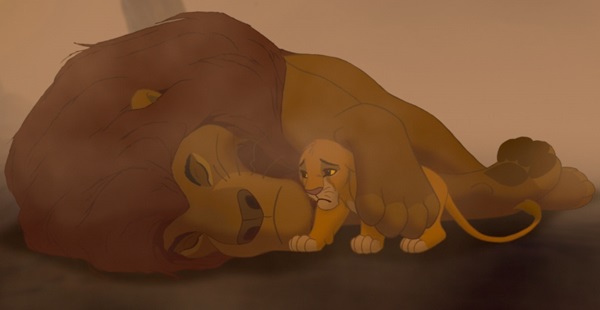 For The Lion King, I knew that there could only be only thing that would do for its turning point. The death of Mufasa. That’s what every child remembers most from this film. And it’s the heart of the film’s structure. Everything at the start of the film points to that moment, and everything after it is a reaction or consequence of it. That is what had to be at the center of the film’s chiasmus.
And I was absolutely right! Mufasa’s death is the turning point of the story in more ways than one. Simba has to fend for himself from then on, the Pride Lands become a wasteland when Scar takes power, Simba is scarred and stunted in his growth, and he has to overcome his shame and regret to take his rightful place in the Circle of Life.
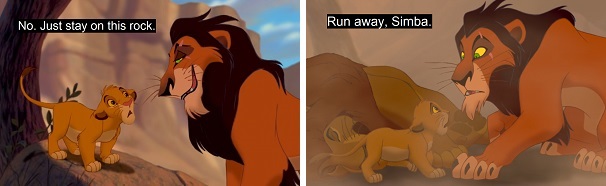 Here are some of my favorite comparisons I noticed along the way. I like that Nala’s child and grownup introductions (F) mirror each other, as do the scenes where Simba receives bad advice from Scar and good advice from Rafiki (E) in relation to his father’s wishes. I really have to credit N for helping me cement the turning point in my mind because it was such a clear parallel. I love how Scar commands both Simba and his hyena friends in both instances and they obey him almost without question. He’s such a snake to worm his way into trusted positions of power. I also like how Timon and Pumbaa are the polar opposite of Mufasa, encouraging Simba to ignore his past rather than face it and heal his wounds at the same point in the chiasmus (K).
There are so many amazing parts of this chiasmus. Those are just a few of the things that stuck out to me. I hope you’ve enjoyed reading this as much as I enjoyed writing it. And I want to thank Jo for inspiring it! She has an amazing eye for these.
This is the Deja Reviewer bidding you farewell until we meet again.
All images are the copyright of their owner.

Want to Support the Deja Reviewer?
If you’d like to support the Deja Reviewer, please consider donating a few dollars to keep this site going strong. I’ll even send you an original joke if you do! Try it, and prepare to enjoy a good chuckle.
$5.00


 Deja Reviewer
Pingback: Magic Mirror on the Wall, What Disney Film Is the Most Symmetrical of All? Snow White and the Seven Dwarfs! | Deja Reviewer
Pingback: Like Its Predecessor, Tron: Legacy Is a Symmetrical Film | Deja Reviewer
Pingback: 60 Examples of Cinematic Chiasmus | Deja Reviewer