Walt Disney’s first foray into full-length animated filmmaking in 1937 is an example of symmetrical storytelling. I’m excited to reveal the chiasmus found in Snow White and the Seven Dwarfs.
First, I should acknowledge the elephant in the room. Three Cinematic Chiasmus articles in a row, two of which are fairy tales? Absolutely! This one is the simplest of the three I’ve written in the past three weeks, way simpler than Ever After and just a little shorter than Forbidden Planet. It’s fitting for a story about cute little Dwarfs and a magic mirror to be nice and short as each side of the film reflects the other.
This would have been timelier a few months ago, but that’s all right. I just take these as they come to me. Let’s whistle while we work our way through the brilliant chiasmus of Snow White and the Seven Dwarfs.
The Chiasmus
This chiasmus wastes no time in getting to its happily ever after.
A. The Snow White storybook opens, and the first line says “Once upon a time”
B. The Queen’s worst nightmare comes true when the magic mirror declares Snow White the fairest in the land
C. Prince Charming is introduced singing a song, and Snow White blows him a kiss to let him know her true feelings
D. The Huntsman hesitates about killing Snow White when commanded to by the Queen
E. The Huntsman drops his knife and can’t bring himself to kill Snow White
F. After the Huntsman saves Snow White’s life, she runs down into a dark forest, getting drenched in a pond, and imagining she’s being chased by scary creatures
G. Forest critters guide Snow White to the Dwarfs’ cottage to protect her from the Queen
H. Snow White is surprised when she arrives at the Dwarfs’ cottage and finds it empty of inhabitants
I. Snow White cleans the cottage to serve the Dwarfs while they’re at work
J. The Dwarfs dig for beautiful gems in a mine, discarding duds that appear among normal diamonds
K. Snow White goes to sleep upstairs in the Dwarfs’ beds
L. The Dwarfs quietly sneak into their home at dusk, and they instantly fall in love with Snow White when they see her
M. Snow White says that dinner isn’t ready yet, so the Dwarfs wash their hands and force Grumpy to wash against his will
M. The Queen learns that Snow White isn’t dead yet, so she gets her hands dirty by willingly turning herself into an ugly hag
L. The Dwarfs loudly sing in their home at night, and Snow White tells them how she fell in love with Prince Charming
K. The Dwarfs go to sleep downstairs and let Snow White have their beds
J. The Queen creates a poisoned apple in her dungeon, hiding it among normal apples
I. Snow White gives the Dwarfs a kiss before they go to work
H. Snow White is surprised when the Queen arrives at the Dwarfs’ cottage and finds her all alone
G. Forest critters guide the Dwarfs back to their cottage to protect Snow White from the Queen
F. After the Queen seemingly kills Snow White with a poisoned apple, she runs up onto a dark mountain, getting drenched in a storm, and being chased by Dwarfs
E. A boulder drops on the Queen after she fails to bring it down on the Dwarfs
D. The Dwarfs don’t bury Snow White after she’s put into a magical sleep by the Queen
C. Prince Charming returns singing the same song he did earlier, and he gives Snow White love’s first kiss
B. Snow White’s dreams come true when Prince Charming brings her to his beautiful kingdom
A. The Snow White storybook closes, and the last line says, “And they lived happily ever after”
So Charming
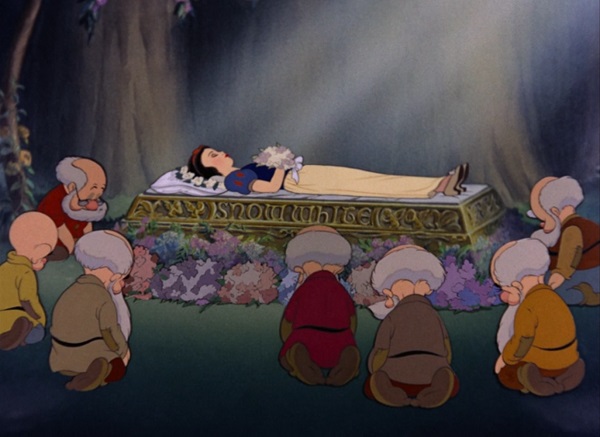 It’s always fun when a chiasmus is literally bookended like this one (A). I found this chiasmus while introducing Snow White and the Seven Dwarfs to my children. They had never seen it before, and I had never considered analyzing it in this way. But as the Queen ran away from the Dwarfs (F) and suffered an ignominious death (E), I suddenly started to see the pieces falling into place perfectly. Then the Prince showed up shortly after right on cue to match with his previous appearance at C.
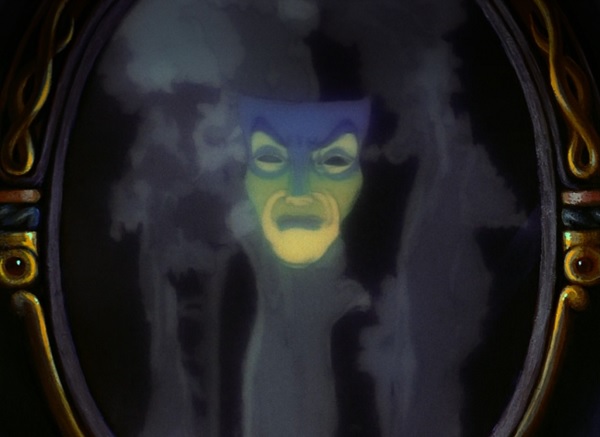 Before the end title card, I was able to confidently say to my wife that this film is a chiasmus. I proceeded to recount to my wife and children A through G. The other letters were a bit fuzzy without my usual notetaking, but we were able to piece them together in no time.
This is one of the shortest Cinematic Chiasmus articles I’ve ever done. It’s not the first Disney animated film I’ve done. The others are The Sword in the Stone, Beauty and the Beast (1991), and The Lion King (1994). I think it’s wonderful that the first animated film produced by Disney would follow this formula. Snow White and the Seven Dwarfs broke the mold in more ways than one.
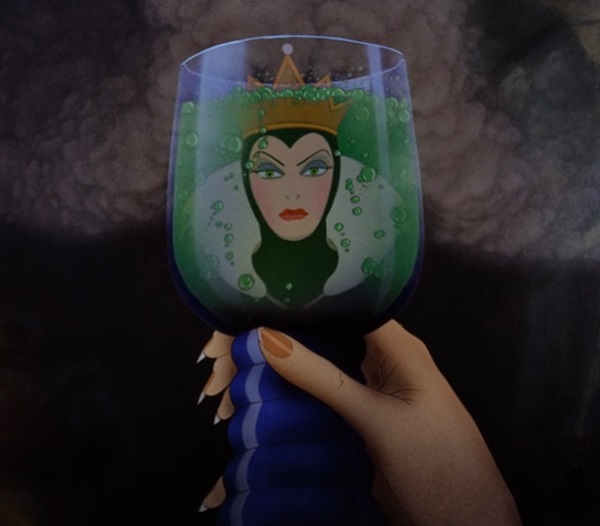 The turning point of the chiasmus (M) is quite interesting. We hadn’t seen much of the Queen up until that point in the movie. But that’s her big scene, the one that every child remembers. I’ll never forget the moment when the Queen reveals her ugly face and scares the wits out of her pet crow. And the fact that it matches up with the Dwarfs doing something they’ve never done before (washing their hands and faces) is fitting. The Dwarfs are preparing to eat a feast from Snow White, while the Queen is preparing to serve a poisonous apple to Snow White. One scene is fun and inspired by adoration and love, while the other scene is terrifying and inspired by envy and hatred.
In other words, they mirror each other perfectly. And they set the stage for the rest of the scenes to mirror each other with astonishing precision, too. You don’t need a magic mirror to tell you that Snow White and the Seven Dwarfs is a perfectly symmetrical film.
This is the Deja Reviewer bidding you farewell until we meet again.
All images are the copyright of their owner.
Want to Support the Deja Reviewer? If you’d like to support the Deja Reviewer, please consider donating a few dollars to keep this site going strong. I’ll even send you an original joke if you do! Try it, and prepare to enjoy a good chuckle. $5.00


 Deja Reviewer
Pingback: 60 Examples of Cinematic Chiasmus | Deja Reviewer