I love Beauty and the Beast (1991). It’s my favorite movie. And it’s a rare movie that actually puts its moral front and center at the very start.
Vincit Qui Se Vincit
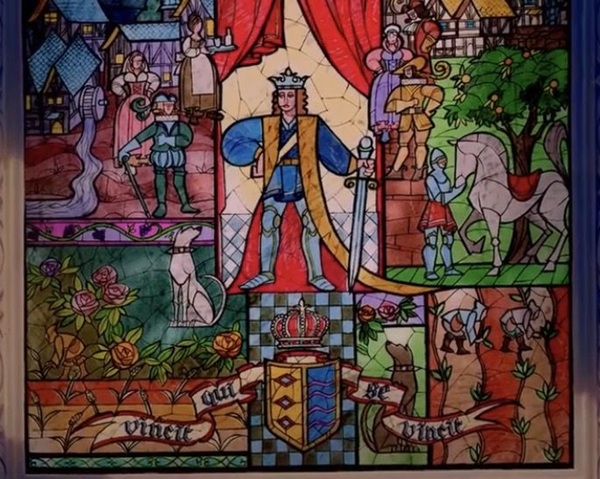 There’s a tiny detail I never noticed until recently. The stained-glass window we see at the start of the prologue contains four Latin words: Vincit Qui Se Vincit. And those four words contain the whole point of the movie.
He Conquers Who Conquers Himself. That’s a profound message for a children’s movie. In Beauty and the Beast, the obvious villain is Gaston. He’s a rival for Belle’s affections. He manipulates a whole town into doing his bidding. He literally backstabs the Beast. But Gaston is more of a symbol than the true villain of the piece.
The real villain is within the Beast himself.
Out of Control
Time and time again, the Beast is told that he needs to control his temper. During the first half of the film, the Beast is ruled by his passions. He is offended that a stranger entered his castle without his permission, so he throws him into prison. Then he orders Belle to join him for dinner and has a fit when she refuses to comply. And finally, he becomes violent when Belle penetrates his inner sanctum of solitude against his will.
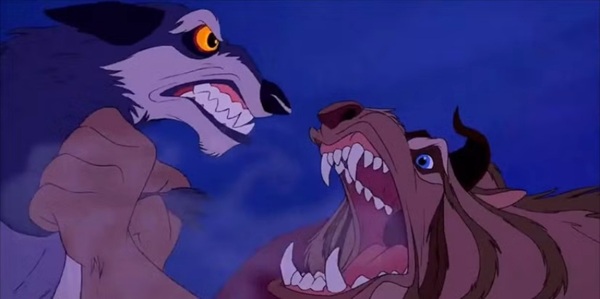 Clearly, he has no idea how to control himself. He’s as wild and dangerous as any predator in the forest.
It’s only when Belle runs away and gets into a life-threatening situation that we begin to see a new side of the Beast. He didn’t know that Belle would fall into the clutches of a hungry pack of wolves. All he knew was that he had driven her away. And, in an act of remarkable self-control, he went after her. It’s never easy to admit when we’re wrong and we’ve made a mistake. I’m not sure what the Beast had in mind as his object. Perhaps he wanted to apologize.
Whatever the case, as soon as he found Belle in danger he sprang into action. He used his wild, ferocious instincts to fight off the wolves at great personal cost. He nearly died saving her life, and she got to return the favor by bringing his unconscious form back to the castle and treating his wounds.
The First Test of Self-Control
The rest of the movie shows the Beast learning greater self-control. Two moments that define his change of heart come when he interacts with Belle and Gaston.
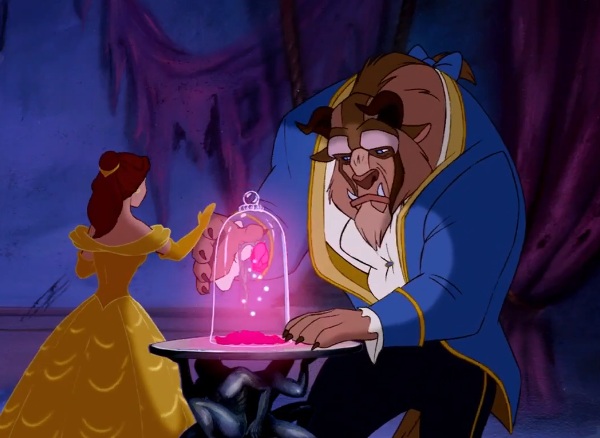 Belle learns that her father is sick and possibly dying out in the cold. Knowing that allowing Belle to help her father is basically a death sentence for himself, the Beast releases her from bondage. He encourages Belle to go to her father. This act of self-sacrifice shows that he has learned to love. Even more than that, it shows that he has begun to conquer himself.
But wait, you might ask, he hasn’t conquered yet. And you’re absolutely right. That comes later. The phrase Vincit Qui Se Vincit doesn’t necessarily mean that conquering happens right away when we conquer ourselves. Our resolve must be tested to see if we will remain true in the most difficult circumstances. Plus, the Beast has one more important flaw he needs to overcome before he can fully conquer himself.
The Beast’s Second Test
The Beast has proven that he is self-sacrificing, but is he also able to overcome his temper? Can he refuse to get violent and take revenge when someone has wronged him? He demonstrates his ability to do even that during his duel with Gaston. Gaston represents a complete lack of control, a willingness to do anything it takes to get what a person wants. He has no scruples. Even though his temper doesn’t flare as forcefully as the Beast’s, it still simmers and leads to all kinds of evil actions.
 That’s why he has no gumption about threatening Belle’s father to get her to marry him after she flatly refused his proposal. She humiliated and disgraced him in front of the whole town, and that’s not something a man like him can ever forget. Or forgive. He is an unchecked version of the Beast. Gaston is the kind of man the Beast would have become if not for the enchantress’s curse and Belle’s love.
After the Beast released Belle, he gave up all hope and fell into despair. So he doesn’t even put up a fight at first against Gaston’s arrows and fists when their fight begins. Gaston taunts the Beast for his passivity. Once he learns that the Beast has feelings for Belle, Gaston sends an even clearer message that Belle belongs to him, not the Beast.
 Hearing that, the Beast’s temper is unleashed upon Gaston. He disarms the hunter, grabs him by the throat, and holds him over a giant abyss. Gaston then proves himself to be a coward as he clamors for mercy. And then something remarkable happens. The Beast’s angry face softens little by little until he is able to look at Gaston in pity and wonder. His anger is gone, replaced by something new: self-control.
The Beast has finally learned to control his temper. Vincit Qui Se Vincit is fulfilled when Belle realizes that she loves him. And that breaks the curse on the Beast and his castle.
Master Our Monsters
Controlling ourselves is hard. Everything seems to be designed to get us to relinquish control through addiction, bad habits, immorality, and carnality. I know that I can easily lose control of myself and give into base desires if I don’t watch myself carefully.
That’s one reason why I’m so guarded with a lot of what I say and do. I’m not perfect, but I try to avoid temptation as much as possible. I suppose that’s why Beauty and the Beast has been my favorite movie for so long. It perfectly encapsulates the lessons I would wish to learn. Controlling myself through self-sacrifice and forgiving others.
When the Beast learned each of those lessons, something remarkable happened. When he learned self-sacrifice, he learned to love another. And when he overcame his temper, he earned her love in return. I don’t think it’s a coincidence that those happened in conjunction, along with the breaking of the curse.
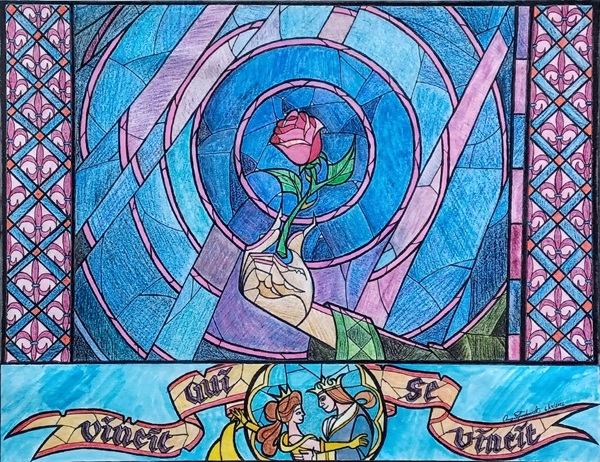 I can’t say I was perfect when I married my wonderful wife, but I was trying to be better. She recognized that quality in me and decided I was worth spending forever with. With her help, I am eager to continue improving and striving to keep myself in check.
Early in the film, the Beast’s servants call him Master, but he thinks Belle will only ever think of him as a monster. Ironically, we all have a monster in us that we must master. Anger isn’t the only thing that can destroy us. The great thing about Beauty and the Beast is that the Beast’s foible is a stand-in for many types of weaknesses. It could be excessive fear, laziness, lust, covetousness, or any other human weakness that we’re dealing with.
The lesson is still the same. Vincit Qui Se Vincit. We conquer when we conquer ourselves. As a famous song called “America the Beautiful” puts it so eloquently: “Confirm thy soul in self-control, thy liberty in law.” Wise words to live by.
This is the Deja Reviewer bidding you farewell until we meet again.
All images are the copyright of their owner.
Want to Support the Deja Reviewer? If you’d like to support the Deja Reviewer, please consider donating a few dollars to keep this site going strong. I’ll even send you an original joke if you do! Try it, and prepare to enjoy a good chuckle. $5.00


 Deja Reviewer
I love this! 💜
LikeLiked by 1 person
Pingback: Another Lesson from The Natural: Evil Never Stops Looking for Our Weaknesses | Deja Reviewer